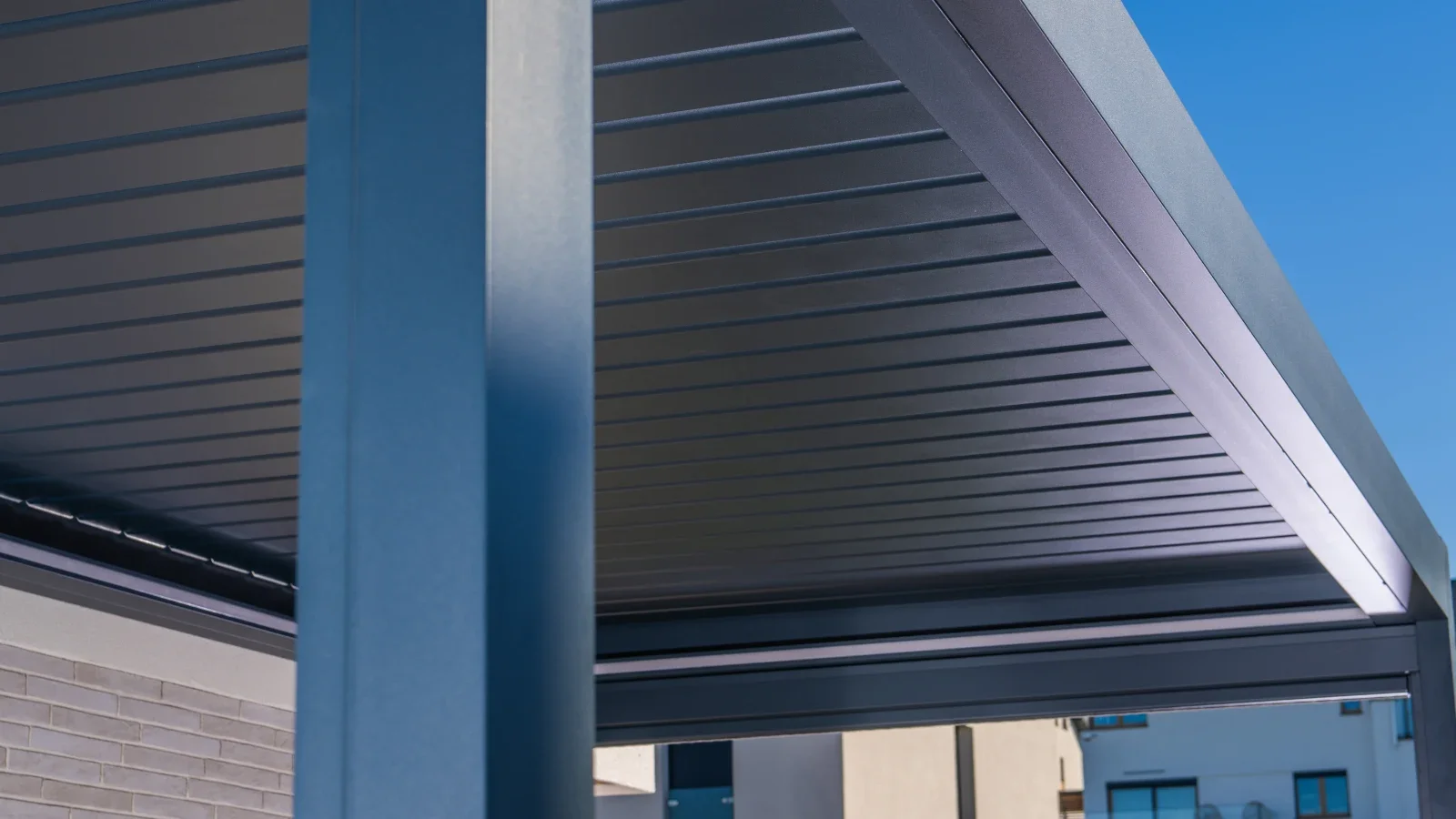
Weighing up an opening roof vs a retractable roof for your backyard? Both offer great shade on a July afternoon and keep you dry when the first winter storm rolls through. But the real difference between an opening roof and a retractable roof shows up on perfect evenings, when you decide what you want overhead.
At Exterior Perfections, we design and install both styles from Louvretec, so here’s how they compare in light, weather protection, and cost, and how to choose the best fit for your backyard.
What’s the Difference Between an Opening Roof and a Retractable Roof?
It comes down to where the blades go. An opening roof’s aluminum blades rotate in place to control sun, airflow, and rain. A retractable roof does the same, then turns its blades to 90° and stacks them away, leaving over 70% of the space above open to the sky.
Both are rigid aluminum louvered roofs, so you’re really choosing between two levels of flexibility, not two different kinds of products.
| Opening Roof (180 Linear / 260 Translucent) | Retractable Roof (220 Retract) | |
|---|---|---|
| Blade movement | Rotates up to 180° | Opens to 135° when extended; turns to 90° to stack and retract |
| Open sky | No, blades stay overhead | Yes, over 70% open space when retracted |
| Light when closed | Blocked (180 Linear) or filtered (260 Translucent) | Blocked |
| Operation | Somfy motor or manual crank gearbox | Somfy motors with Daisy app control |
| Frame | Freestanding or attached | Two-sided (stacks against the house) or three-sided |
How an Opening Roof Works
Louvretec’s opening roof runs on a Spiral Pivot Operating System. Tilt the blades to angle out the afternoon sun, open them to let trapped heat escape, or close them flat onto a soft wool pile strip when the rain arrives.
The value lies in the engineering. Each blade is 6061 aluminum alloy, turning on a marine-grade stainless steel hex bar, and the gearbox and Somfy motor are hidden inside the frame, protected from sun, rain, and salt air. The 180 Linear also carries 7¼" gutters on all four sides, finished with a clean picture-frame edge.
Want daylight even with the roof shut? The 260 Translucent adds an Acrylic Naturelites Plexiglas® in-fill to every blade. With a manual crank option, an opening roof can also suit simple setups.
How a Retractable Roof Works
The 220 Retract was developed in Australia with Advanced Design Innovations (ADI). When extended, it works like an opening roof, with blades that open up to 135° for shade and airflow. Press a button, and the blades turn to 90° and stack into just 28% of the opening.
That’s the moment the space changes. You get the full winter sun on the patio, stars over a summer dinner, and an unbroken view of the hills. Press the button again, and you’re back under full cover, with an integrated gutter channeling rain into the hidden perimeter frame.
It runs on Somfy motors and is controlled via the Daisy app. You can choose a two-sided frame that stacks the blades against the house or a three-sided frame that clears the sky completely.
Louvered vs Fabric Retractable Roofs
Many products sold as retractable roofs are fabric canopies that slide along a track. A Louvretec Retract uses rigid aluminum blades instead, so it still tilts for shade and ventilation when extended and doesn’t rely on a fabric cover that needs replacing over time.
Opening Roof or Retractable Roof: Which Suits the Way You Live?
Choosing an opening roof or retractable roof is less about specs and more about how you’ll use the space. Here’s how we usually guide homeowners across the Bay Area and Sacramento.
Choose an Opening Roof If…
- You’re outside most days and want instant shade control through long Sacramento summers.
- Your yard sees steady wind, like a coastal or hilltop Bay Area lot.
- You want natural light with the roof closed (260 Translucent), or you’d prefer a manual option.
Choose a Retractable Roof If…
- Open sky matters to you, whether that’s stargazing, winter sun, or a view you’d rather not frame with blades.
- You’re covering a pool, spa, or garden that needs full sun at times.
- You want the most flexible setup, and your budget allows for a higher retractable roof cost.
Still torn between an opening roof or a retractable roof? That’s completely normal, and it’s exactly what a site visit is for.
Opening Roof Cost vs Retractable Roof Cost
There’s no single price for either system, as each roof is custom-built for your space. Your opening roof cost depends on:
- Overall size and span
- Freestanding or attached to the house
- Local wind conditions and the engineering they require
- Motorized or manual operation, and your choice of controls
- Powder coat color and finish
- Add-ons like infrared heaters, zipper screens, and recessed LED lighting
- Permits and site preparation
Your retractable roof cost is shaped by the same factors, plus the stacking mechanism, extra drive hardware, and frame configuration that let the blades clear away. That’s why a retractable roof generally costs more than an opening roof of the same size.
Either way, you’re investing in marine-grade hardware and enclosed moving parts that keep upkeep to a rinse and light clean. If you’d like to spread the cost, we offer financing options across the Louvretec range.
Finding the Best Roof System for Your Outdoor Space
The best roof system for your outdoor space is the one designed around your home, local weather conditions, and your daily habits. Our process keeps it simple:
- In-Home Design Consultation: We measure, assess drainage, and talk through how you plan to use the space.
- Engineering and Permits: Our team prepares the plans and handles the permit process with your local building department.
- Installation and Aftercare: Our trained installers fit your roof, and the same team stays on hand for adjustments and servicing.
Ready to compare an opening roof vs a retractable roof in your own backyard? Contact us to book a free in-home design consultation and estimate in the Bay Area or Sacramento.
Frequently Asked Questions
-
Yes. When the 220 Retract’s blades are fully extended and closed, they form a sealed roof. Rain runs into the integrated internal gutter and drains through the hidden perimeter frame, keeping the space underneath dry.
-
Retracted, the 220 Retract leaves over 70% of the space open to the sky. With the roof closed, the 260 Translucent opening roof is the only Louvretec option that still lets filtered daylight through.
-
Extended, it performs like an opening roof. Louvretec advises that wind can affect blade movement while the roof retracts, so retract in calmer conditions and keep the blades extended in strong winds.
-
It depends on how much you value open sky. If you mainly want shade and rain protection, an opening roof covers it. If clear views and full sun are part of your dream backyard, the retractable roof earns its place.